
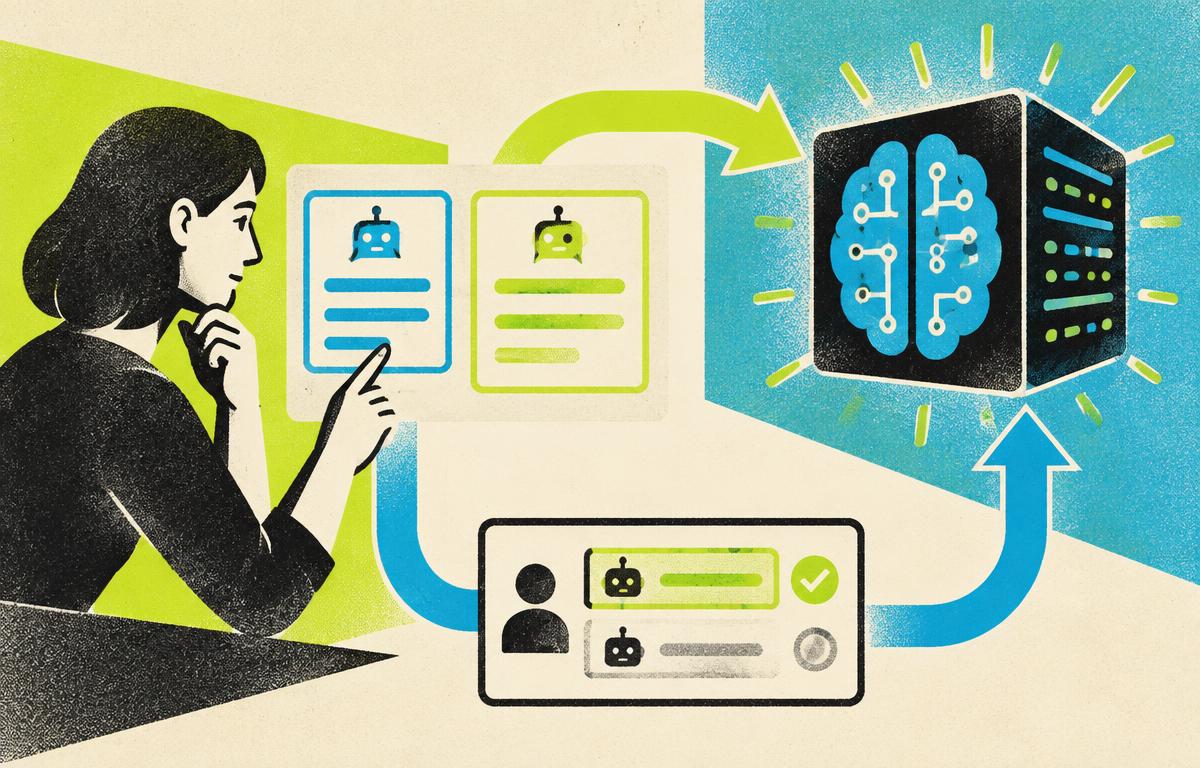
Reinforcement learning from human feedback, usually shortened to RLHF, is one way AI systems learn which responses people prefer. Contractors do not usually train a model directly. They produce carefully structured judgments that become training or evaluation data.
The feedback loop in plain English
A model produces possible responses. Human reviewers compare or score them under a rubric. Those judgments are aggregated and used to shape later model behavior or to measure whether a new model is better. Related methods may use preference data without the exact same reinforcement-learning step, but the evaluator’s job can look similar.
What preference ranking asks you to do
You may see two answers to the same prompt and choose A, B, a tie, or a severity rating. Good ranking is multidimensional: an answer can be fluent but wrong, correct but incomplete, or helpful but unsafe.
- Correctness: are the claims and reasoning sound?
- Instruction-following: did it satisfy the user’s constraints?
- Relevance: is it focused on the actual request?
- Safety: could it cause harm or violate policy?
- Style: is it clear, professional, and appropriately concise?
Why the rationale matters
A label says what you chose; a rationale explains why. Strong rationales point to a specific difference and connect it to the rubric. They avoid vague comments such as “A feels better” and avoid inventing problems that are not present.
Key takeaway
The most useful feedback is specific enough that another careful reviewer could reproduce your decision.
RLHF-adjacent work
Listings may instead mention red-teaming, prompt writing, model grading, safety evaluation, supervised fine-tuning data, or direct preference optimization. These are not interchangeable technical methods, but applicant skills often overlap: close reading, domain knowledge, consistency, and clear explanations.
How to prepare
Practice comparing answers using a fixed checklist. Read one answer at a time, verify important claims, then compare. If you are applying as a specialist, refresh the standards and edge cases of your field rather than memorizing AI vocabulary.
Sources and further reading
External sources support the definitions and current signals in this guide. Availability and platform requirements can change.
Put it into practice